Saturday, April 17, 2010

Ponchos pilot

If Tom Bodett is to be believed, ponchos are about to come back in style. Tom returns as the Motel 6 spokesperson and he’s predicting ponchos will the next big thing. If you accept the rationale Tom presents in the latest Motel 6 radio commercial, it has to make you wonder.

Cue the violin…

“Ponchos may not be in style, but mark my word, they will be. How do I know?” Tom goes on to explain that for more than two decades Motel 6 has been talking about how their guests can get a nice clean room with a comfortable bed for just about the lowest price of all of the national chains. Suddenly, frugal is in and everyone’s bragging about the great deals you can get. “What’s next? Ponchos!” Tom exclaims.

“I’m Tom Bodett in a sassy poncho for Motel 6 and we’ll leave the light on for you.”

I’m so glad you’re back, Tom.

Monday, February 22, 2010

Embrace life at the moment of impact

There are some advertisements that are so very, very powerful and moving, they become a global and social media sensation almost overnight. Do you recall the Texting While Driving PSA that caused quite a stir last summer with its graphic depiction of the consequences of distracted driving? Embrace Life is rapidly moving toward that same level of global awareness and impact. Check it out.

Are you in awe?

The instance that really captures me emotionally is at the imaginary point of impact when he thrusts forward and the table and glass goes flying in super-slow motion. His wife and daughter hold onto him for dear life, protecting him and keeping me from flying through the windshield and potentially into another life. That's a WOW moment.

The advertisement artistically impresses me immensely. I hold in high esteem those with the creative minds and directorial skills to produce such an important message (with no spoken words and a magnificent music bed) in a 90 second window. Simply wonderful.

Embrace the message…Embrace Life.

###

To learn more about the Sussex Safer Roads Project and the Embrace Life campaign, click here: Sussex Safer Roads Project

An independent Facebook group supports getting this PSA placed on TV stations around the globe. If you’d like to join it, click here: Embrace Life Facebook group  NOTE: By clicking, you may automatically join the group.

embrace life seat belt ssrp advert creative film family car motoring driving crash psa commercial video sussex safer road official daniel cox

Sunday, January 10, 2010

Call off the tanks

While watching the Alabama Crimson Tide tackle the Texas Longhorns in the 2009 BCS National Championship game, I found myself more engaged with the commercials than with the program they were sponsoring. That’s not unusual for me because I love advertisements.

What made enjoying the commercials more challenging was that the party hosts muted the television during every game break. I find this behavior amusing, and, as an advertising professional, a bit disturbing. But what are you going to do?

As a new installment in the Bud Light “Drinkability” campaign began, I uttered, “I love this commercial.” One party guest turned to the television and said he liked the commercial, too. That drew the attention of a few others. We laughed softly as the Paintball “Too Heavy” air attack ensued. After the two combatants clinked bottles and the winner raised his walkie-talkie, I parroted his last command, “Call off the tanks.” Several people chuckled. The gentleman who first paid me attention turned and asked, “Is that what he says?”

“Call off the tanks” is probably spreading across the continents as the latest catch phrase. If you hear it, write a Comment describing when, where and under what circumstances it was used.

Thursday, December 24, 2009

Put on a happy face

Take a look around you. There are faces in the everyday objects you wear, use and observe. Some are frowns. Some are smiles. Do you see them? They are everywhere.

An advertising agency produced a television commercial that has captured a number of these objects with facial expressions and used them to capture the viewer’s attention. I’m sure you’ve seen it, but if you haven’t, you’re in for a treat:

The first time I saw the commercial I was mesmerized: completely taken in by the visual medley. In fact, I was so absorbed by what I was seeing, the music and the voiceover were nearly unnoticed. That  probably has more to do with me than with any flaws in the creative execution.

I’ve seen the commercial dozens of times now and I am still wowwed. It has the entire package: superb imagery, a dynamite music bed, and an intelligent script that is perfectly paced and spoken. I applaud the creative team and American Express for recognizing that the pictures convey a thousand words, so the announcer need not.

A breakdown of the commercial:

  • 24 images:  10 frowns, smartly outnumbered by 14 smiles
  • 5 frown images are shown in the first 8 seconds before a single word is uttered
  • As we see the second 5 frowns, the announcer mentions the bad things that can happen to the items we purchase
  • The first smile image doesn’t appear until the 25 second mark (I love how the indicator light pops on with a beep immediately after the announcer says “Happily” … brilliant!)
  • The name of the advertiser and product is finally mentioned at 27 seconds (smile) - and isn’t spoken again (bigger smile)
  • The airport baggage carousel is the only obvious image tie-in to the copy; “and peace of mind when you travel”
  • The American Express charge card is shown in the last five seconds
  • The music is Bach’s Cello Suite No. 1 in G Major; this choice is a stroke of genius

It’s a terrific advertisement. I can’t help but smile every time I see it.

Sunday, December 13, 2009

Sony Bravia HDTV commercial is "on fiah"!

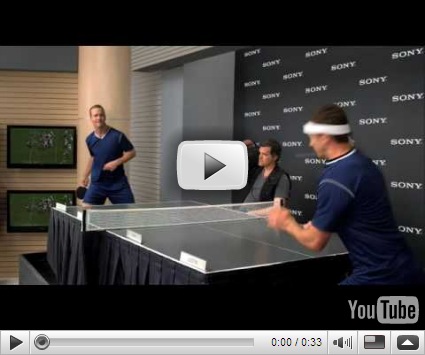
I absolutely love the Sony Bravia commercial with Peyton Manning and Justin Timberlake playing ping pong.

With all of that action and the star power of Peyton Manning and Justin Timberlake, you’d think the message would be lost, or worse, seem like a distraction. Perhaps, save for a simple script that is flawlessly executed. Equally crucial to the commercial’s success is the impeccable visual balance of the set. It allows the viewer to look at Erin Andrews as she speaks and still see the point that is being articulated - and played. The video editing is also superb. Kudos to the advertising agency.

It’s a typical situation: an HDTV shopper looking at all of the flat screens expresses a common consumer frustration “These all seem the same.” What happens next is preposterous. The display wall slides open to reveal Manning and Timberlake playing an incredible ping pong point. Seated on the far side of the table are Tom, the cameraman, and Erin Andrews. Both are seemingly oblivious and unimpressed with the paddle action in front of them. Manning responds to the consumer “They’re not” as he rhythmically hops and smacks the ball back to his opponent. Andrews explains that you can’t fake Sony quality which makes watching sports in HD even better. Musician-and-actor-turned-budding-sports-star Timberlake exclaims that the more you watch sports on a Sony the better you get at sports.

Really?

It appears so because Timberlake gets the best of Super Bowl champion quarterback Manning with a slam for a winner. What follows next is comic brilliance.

You have to hand it to Sony, allowing so much of their commercial to be about the entertainment experience. Isn’t that precisely the point when watching programs on HDTV?

Tuesday, November 17, 2009

Rome didn’t fall in a day; it took the pills much longer to take effect

Back in the day (that would be college), a buddy and I took notice of the tendency for people to “take their medicine” whenever something didn’t feel right. Their medicine was typically a pill:

Take a pill!
Achy? Weak? Take a pill! Hot? Cold? Take a pill! Lethargic? Hyper? Too fat? Too skinny? Take a pill! Sad? Frustrated? Foggy mind? Racing mind? Dark thoughts? Stupid thoughts? Anxious thoughts? No thoughts? Take a pill!

We had many other lines, and I swear, the pharmaceutical industry stole some of them and developed actual pills to cure the ills.

In my previous post, I lamented the expansion of the pharmaceutical industry, its intrusion into all aspects of our existence, and the aggressive advertising of drugs for all kinds of medical, health, and quality of life issues. I closed the post asking a bunch of questions about the responsibilities of all of the players. I will now attempt to briefly discuss these questions.

The Pharmaceutical Manufacturer
I am disgusted and appalled by the number of pharmaceutical advertisements running on television. I could go on a rant on how insidious they are and how many lack originality or creativity, but that is an issue for another post. My concern is with the legitimacy of some of the elixirs being promoted and the responsibilities of the pharmaceutical manufacturers that produce potions and pills for obscure or new syndromes or disorders. 
  
A few pharmaceutical companies are modern day carpetbaggers. They've “discovered” afflictions, intimate it affects many of us, and lo and behold, they have the only treatment; or they sensationalize a very obscure malady - obscure because it affects 1 in every 10M humans, which equates to about 600 people in the entire human race - and their patented formula, relieves the symptoms and allows you to lead a more normal life. Oh yea, right.

Pharmaceutical manufacturers have a civic, moral and ethical responsibility to assure us that profit never trumps public health.

The Advertising Agency
Advertising agencies have a significant responsibility as the messengers for their client’s goods because they have insight into the client’s secrets. To me, they are a gatekeeper for the public welfare. Is the syndrome or affliction real and prevalent? Is the disclaimer long and the potential side effects so disturbing you wouldn’t give the medicine to your mother in-law? Is this a drug that previously treated a different affliction that’s apparently been repositioned for financial gain (as opposed to the public good)? These are just three of the many questions advertising agencies should ask themselves about the drugs in their portfolio. If the account and creative team struggle to find the value proposition and key differentiators; if they spin their wheels developing a compelling script; if they need a speed talker to rip out the warning statement, alarms should go off. And the agency should consider if their relationship with their client is more valuable to them than the well-being of society at large.

The Physician Community
Physicians also need to look at their relationship with the pharmaceutical industry. They must be above reproach. Serving as the pimp for a specific drug or company is unacceptable. Many patients simply trust doctors.  It is incumbent upon physicians to know the drug intimately, understand all potential side effects, contraindications, its competitor's drugs, generics and so on, and provide the patient options ~ including some that don’t involve medicines, when possible.

The Government
Our government certainly has a role here. It's clear industry self-policing is a fallacy. It is not a coincidence that pharmaceutical industry spending on advertising has grown exponentially since 1997, the year the government removed regulations on pharmaceutical advertising. That alone should incite elected officials to revisit the decision to deregulate. Our fearless leaders must be the people's advocate and not bow to lobbying or threats to support opponents or withhold campaign contributions in upcoming elections. There’s simply too much at stake.

The Buying Public
Too many people seek a quick-fix. A magic pill. Few want to put in the effort to realize the reward. It's the same mindset that makes lotteries, casinos, frivolous lawsuits and entitlement programs so popular. But with the Internet only a click away, the public has immediate access to incredible volumes of information from qualified sources. The public should be better able to discern the legitimacy of a remedy, or at least take the initiative to research the syndrome or disorder and the proposed drug, prior to seeking a prescription or making a purchase.

I recognize I’ve only scratched the surface here, but to adequately examine the issue and flesh out the arguments would require a dissertation. This is a blog, and this post is already too long.

In summary, we all need to hold each other accountable. The drug companies can’t make money unless we buy their products. We mustn’t be duped into believing every little affliction or ailment requires a pill or vial. Sometimes, we need to examine if a lifestyle change, and a little exercise, will make us feel better. Such a course will take time. After all, Rome didn’t fall in a day.

What are your thoughts? Do you have any concerns with the actions and advertisements of some members of the pharmaceutical industry? Do you agree with my sentiments? Or do you think I need to take a chill pill?

Monday, November 2, 2009

Pharmaceutical manufacturer develops treatment for wild hair syndrome

Of course advertising works. The proof is in the glut of commercials on television for pharmaceutical drugs. Considering the immense cash expended in research and development, and the rigor involved in testing drugs, one has to assume pharmaceutical manufacturers do their homework when it comes to advertising. They know their customer. They know when, where and how to reach them. They know advertising pays huge dividends.

But at what expense to humankind?

Look at what has happened to our society. We put substances into our body to treat all sorts of discomforts and dislikes. Don't get me wrong, I'm all for relieving pain and correcting physical maladies and chemical imbalances that affect quality of life. But I question what we are trying to do when we take prescribed and OTC medications for every little twinge, ache, discomfort, imperfection and shortcoming.

For a certain portion of our population, it’s the path of least resistance. It takes absolutely no effort to pop a pill instead of getting on a treadmill or following a prescribed diet, lifestyle change, physical therapy or rehab regimen.

Pharmaceutical manufacturers recognize this is an exceptionally lucrative market and they are being very creative in developing remedies with appealing names for all kinds of medical, quality of life and vanity issues. Some are now described as a syndrome or disorder that also bears a creative name (such as the fictitious syndrome in this post’s title) that was probably assigned by a savvy marketer or a professional naming/branding firm. The medical community and the public didn’t know of this syndrome or disorder until we heard it described in a TV or radio commercial, or read about it in an advertisement.  In some cases, a close examination of the name of the “condition” by a thinking person would have him or her scratching his or her head thinking “What? Seriously?”

Unfortunately, the public is buying, regardless of the legitimacy of the syndrome or disorder, or the necessity of any kind of treatment.

What may be worse is how drugs have become the base for superficial gain.

Perfectly healthy people inject, swallow or smear to artificially enhance so they can look or perform better. It's superficial, vain and perhaps a bit reckless. Sometimes, the drug provides short-term results, but what about the long-term consequences? Many will discover them as health issues begin to arise in the ensuing years. With luck, if any delayed side effects arise, they will be minor. But that’s a bit like Russian roulette, isn’t it?

What is the pharmaceutical industry's responsibilities here? What about the advertising agencies? How are they culpable? How about the physician community? Is the federal government being vigilant enough in reviewing the efficacy of new drugs and the claims manufacturer’s publish? How closely do they review the data? And what about the consumer? How is he or she accountable for what is prescribed or voluntarily injected or ingested for medical, quality of life or vanity purposes?

I will attempt to answer these questions, keeping in mind this is an advertising blog, in upcoming posts.